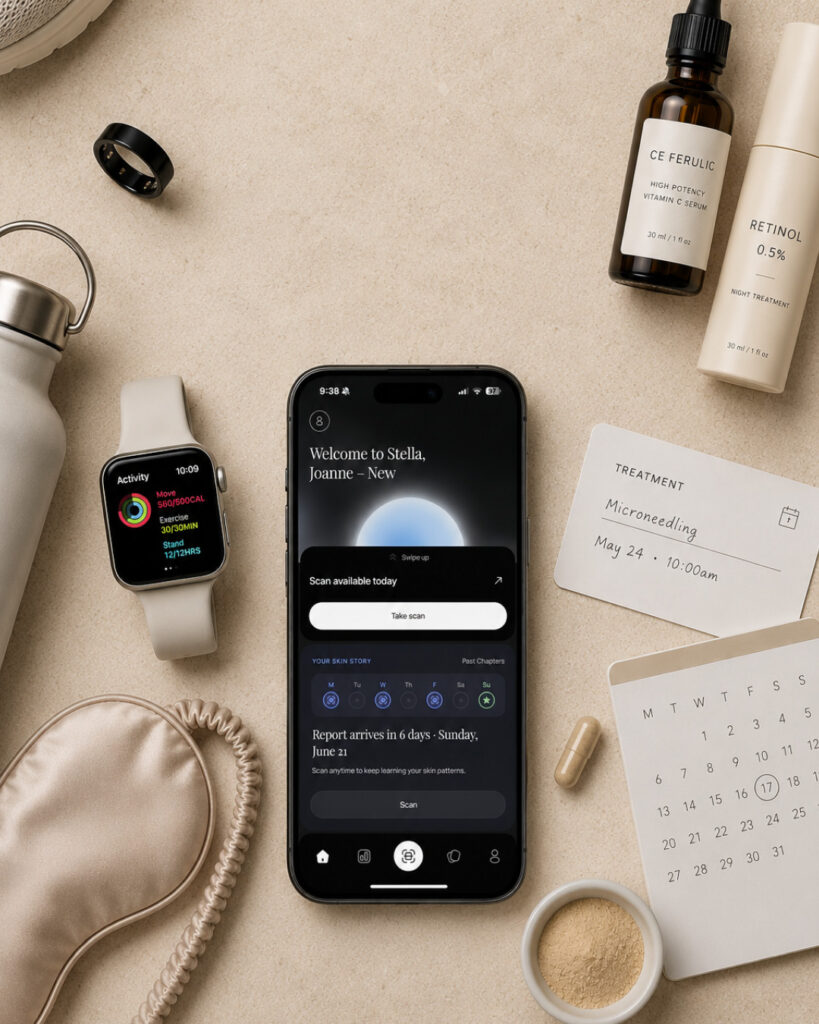
Most of us judge our skin by the morning mirror. But what if that’s the wrong way to look at it entirely?
There’s a moment most of us know well. You wake up, check your skin, and suddenly your entire routine is in question. Was it the new serum? The late nights? Something you ate? You change something, wait a week, change something else — and before long, you’ve lost track of what you were even trying to figure out in the first place.
It’s a cycle that Joanne Wismeyer, co-founder of Australian skin-tracking app See Stella, has spent years thinking about.
“We kept seeing the same pattern. People would abandon a routine after a bad week — one that may actually have been working. They’d chase a new trend because they had no reference point for what was actually changing on their skin. And the question we kept hearing, from patients, clients, friends, was always the same: how do I know if this is actually working?”
The answer, it turns out, requires a different relationship with time.
Skin doesn’t move the way you think it does
Here’s something most skincare products don’t tell you: skin is slow. The processes that drive real change — cell turnover, barrier repair, how your skin responds to an ingredient — play out over days, weeks, sometimes months. A retinoid typically needs six to eight weeks before there’s anything meaningful to read. Which means that what you see in the mirror on any given morning is, at best, one frame from a much longer film.
It’s a concept the team at See Stella call “skin as slow biology”, and it’s the foundation that the app was built on.
“One of the biggest misconceptions about skin is that you can judge it from a single moment. Skin changes over weeks and months, not hours. Looking at trends over time gives a much more meaningful picture.” — Dr Alice Rudd, Consultant Dermatologist and Co-Founder, See Stella
The problem is that most of us aren’t equipped to track those trends. Memory is unreliable — we overweight the bad week and forget the slow, steady improvement that came before it. And without a record, it’s almost impossible to separate a genuine pattern from everyday noise.
What Stella actually does
See Stella is a skin-tracking app designed to show you what your skin is doing over time — not just right now. Using your phone’s camera, a 30-second scan tracks 23 metrics across eight facial zones: sensitivity, clarity, tone, pigmentation, ageing, and the eye area. Repeat that scan over weeks, and patterns begin to emerge that a single moment simply can’t reveal.
But the scan is only part of it. Stella also brings together your skincare routine, wearable data — including sleep, activity and stress metrics from devices like Oura and Apple Health — and the environmental conditions your skin is living in. Because, as the app’s founders are quick to point out, skin doesn’t respond to your moisturiser in isolation. It responds to your whole life.
“Steady shifts that a mirror misses, patterns that only become visible when you’re tracking consistently — that’s what Stella surfaces. One unusual scan never overrides an established trend.”
For anyone who’s ever wondered whether a new product is genuinely helping, or whether their skin is just having a better week, that distinction matters.
An industry built differently
In a wellness space crowded with apps that recommend products, earn commissions, and serve sponsored content, See Stella takes a deliberately different position. The app doesn’t sell skincare, earn referral fees, or take brand partnerships — which means, as Joanne puts it, there’s no reason for it to tell you anything other than what your skin is showing.
That philosophy extends to how the team thinks about what success looks like for their users.
“We built Stella because we were tired of an industry that often profits when people feel worse about themselves. Sometimes the answer isn’t a new product. Sometimes it’s giving your skin time, simplifying a routine, or changing nothing at all. We want users to replace guesswork with understanding — and to build a calmer, more informed relationship with their skin.”
What it looks like in practice
Open Stella, do a 30-second scan. Log what you used last night. Connect your wearable if you have one. Then do it again next week, and the week after that.
Over time, the app shows you directional change — not a verdict on your skin today, but a picture of where it’s been and how it’s moving. “Your texture scores have been steady for four weeks” is the kind of insight Stella is designed to surface: the kind that a morning mirror, and a busy mind, simply can’t hold onto.
Upcoming features will also help users explore how their skin shifts across different phases of their cycle — a layer of context that, for many women, has long been missing from the skincare conversation.
The advice Joanne wants you to take away
We asked Joanne for one piece of advice she’d give every reader thinking about their skin. Her answer is as straightforward as the app itself.
“Stop judging your skin by this morning’s mirror. Your skin is a film, not a frame — watch what it does over a month.”
See Stella is available on iOS and Android. Visit seestella.co
For your exclusive SPECIAL OFFER enter the code: FIT1MO